Select your CCTV camera(s)
ATSS has an extensive range of cameras for all different requirements.It is important that you select the right camera for it to acheive its individual job. These are the factors you will need to consider to help you choose the right CCTV camera.
1. CCTV Purpose
2. CCTV Performance
a. Monitor and control general situation
b. Detection of person
c. Recognition of person
d. Identification of person
e. Number Plate Recognition
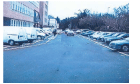
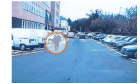
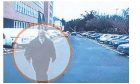

Your CCTV requirement will determine what sort of performace you require from your cameras.
The most common complaints for the disappointing performance of many CCTV systems include:
3. CCTV Type
a. Analogue
b. IP (Internet Protocol)
Go for the traditional analogue or the newer digital network (IP) cameras that connect directly into your network.
4. CCTV Environment
You You need to monitor one or more cctv cameras, record them and access them over the internet remotely.
a. Indoor - dry and reasonable temperaturesb. External - wet and varied temperatures
c. Vandal Resistant - potential for damage quite high
5.CCTV Camera Mount
a. Wallb. Ceiling
Other_________
6. CCTV Picture Format
a. Colour
b. Black/White
c. Day/Night: Max. viewing distance needed in the dark (m)___
Picture Format
The most popular picture format is in Colour, to give you pictures as you are used to on TV.
You should consider Black/White cameras if your budget is limited, light conditions are low or variable.
Day/Night Cameras are ideal for seeing in full colour during the day and in B/W at night. They use Infra-Red LEDs to see at night and can see varied distances when dark.
Ask yourself:
1. Do you need to see at night?
2. Do the light conditions vary a lot?
3. What type of light is there (if any)?
(ie. strip lighting, light bulb etc)
7. CCTV Camera Format
a. DomeCamera - Dome Camera mostly used in interior circumstance.
b. C Mount Camera - C-Mount Camera is that the lens can be changed used for a large commercial building where you need more distance view.
c. IR Camera - IR cameras with infrared illuminators for day and night time surveillance.
d. Speed Dome Camera - Speed Dome Cameras can move side to side (pan), up and down (tilt), and zoom in and out (zoom).
8. CCTV Lens Type/Picture View
a. Fixed Lens
b. Varifocal Lens
c. Lens Size needed:
Max. width needed (m)___
Max. view distance (m)___
Lens Type
The smaller the lens size, the wider the camera view. The larger the lens size, the narrower the view. ie.
The wider the angle the smaller things will appear. The narrower the angle, the bigger things will appear.
Ask yourself:
What will be the maximum viewing distance I need to focus on?
What is the maximum width of that view at that point?
9. CCTV Camera Visibility
a. Overt/Deterrent
b. Covert/Hidden
c. Small/Discreet
10. CCTV Picture Quality
a. Standard under 520 TVLb. High over 520 TVL
Picture Quality
TVL (Television Lines) are the number of horizontal lines produced by a security camera and is a measure of picture resolution or sharpness. The higher the TVL, the better the image quality.
Ask yourself:
What sort of image quality do I need for the purpose of this camera?
Does the purpose require a good image or a general overview of the environment?
Is it required for evidential purposes?
11. CCTV Cabling
Cabling There are many ways to connect a CCTV camera.
Wireless (2.4 GHz) - Wireless via a 2.4 GHz analogue or Local Area Network. This method can be prone to interference and can only work for up to four cameras.
Wired
a. Video Coaxial Cableb. RG6 with Power wire
c. Cat 5 / LAN
d. UTP Cable
e. Fibre Optic Cable
Cabling Distance to control equipment?
(ie. to TV or DVR)___
Using traditional copper wire - the most common way of connecting a CCTV camera. Usually Video Coaxial cabling that is pre-terminated and ready to use or RG6 which will need to be crimped at the ends, Or finally using Cat 5 network cabling to transmit data over a Local Area Network/Internet UTP Cabling is both in expensive and ideal for transmission of video signal upto 1350m. Fibre Optic Cable is suitable for more than 1 Kilometer.
Ask yourself:
What is the ease of running the cable?
Will visible wiring be a problem?